Tuesday, May 13, 2008

Top Ten reasons you've been in Sudan a long time...


1. You say "sorry, sorry" when someone trips or you hear of a mutual friend being ill.

2. You get excited over canned fruit or canned cheese, and popcorn becomes a vegetable or even a replacement for a meal.

3. When shooing the flies away after you flip up the toilet seat becomes normal.

4. Everyday conversation is about food back home and you begin to salivate over the thought of lettuce, broccoli, or anything green.

5. When 77 degrees Fahrenheit is unbearably cold.

6. You pray for rain so that you can bathe and do laundry without having to take several trips to the borehole.

7. You pray that it doesn't rain so that your clothes will dry, and so that your home-made yogurt doesn't get spoiled while your in town.

8. Walking 200 yards in the middle of the night to the latrine (sometimes several times), while winding a flashlight, is normal and part of your workout routine.

9. You can remember how to say a word in Juba Arabic and even French (from College), but not English.

10. When you see an airplane and you stop mid-sentence to see what kind it is, and if it lands you run to the airstrip with all the rest of your Sudanese friends just to see modern technology at its best.

Wednesday, May 7, 2008

In Town


This is a child I saw in town today while walking back from the market. I quickly grabbed my camera from the house and gave him/her candy in return for the great costume/snow suit in 85 degree weather. Hopefully I didn't make the child feel self-conscious. I thought I'd share it with you.

Monday, May 5, 2008

Mong, Mong


Well the Scotlands and the Lobwaya Canadians have gone, along with Chris "black bull" Machar, who has been visiting us for a few months. Now it is Lydia and I as the reprentative kewajas in town. In 3 weeks we too will be leaving-- Lydia to the U.S., and me to Kenya.
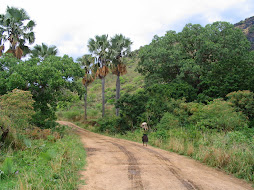
I have started running again, although I am nursing that stress-fracture. It seems that it is hard to shake it with all the walking that I have to do around here. At home, I'd be dong a lot more driving and would probably wear some kind of boot, but here you walk or die (that sounds dramatic, but in the end, that’s true). I am only running 6k every other day so that my foot can still heal, but I can start my training for the half marathon I will be doing in October. I used to only run to the air strip and run the air strip and run home, but Lydia has introduced me to the idea of trying new things. So, lately I have been running down to a seasonal river and then running to the Catholic compound, and then back home. I hope that the fact that I am running in sand will mean that I'm way faster when I return to asphalt and sub-80 degree weather.
On my runs, I have learned the secret to greeting people along the way. Before I was gasping out the very breathy "Salem!", but recently have discovered the use of the local language greeting "Mong, mong!"
"Mong" is a lotuho (lotookoh) or lokwah greeting that is usually followed by 5 more "mongs" and then "Nguy" or "Ngola" or "detally". Nguy means "how are you?" in which you respond, "Ngiita" or "ngiita be be," which means "good" or "very good." So a typical conversation would involve an old lady or old man (because the younger generation speaks more in Arabic or English) holding your hand with 2 hands and saying "Mong, mong, mong,mong mong, nguy?"-- me: "ngiita."-- them: "aywah!" (meaning oh, that's good-- pronounced "eye-wha." When I'm running I usually forget the whole handshaking part and just throw both hands in the air like "don't shoot!" as a sign of respect as I gasp out "mong, mong!"


(road I run on towards the river)
The older people that are out walking in the morning seem to enjoy that I can speak the local greeting and I am also happy because it is easier to say. Even Callum, who is just about 2, can say the local greeting when someone enters the compound.
Since I have returned from Kenya, it has been hard to find anyone to help me with getting water from the borehole, so for the past two months I braved putting a jerry can on the back of Jordan's bicycle and ride to get water. Last Christmas when I tried it with a different, more large, bicylce, a six year old had to come to my aid! On Friday I attempted 2 jerry cans on the bicycle, which resulted in the reinactment of the Wright Bros. first take off. However, I didn't fall despite the rocky (literally) beginning and made it all the way to the church compound where I slowed down to get into to the gates and the jerry cans fell off right outside my compound. I was pretty proud of myself for making it that far. So, these days there are no 6 year olds in need to save me.
At the borehole there is usually a congregation of women and children no matter what time of day. This is usually a good time to practice juba Arabic and socialize with the other ladies. Sometimes they call me "Uma Lumuuno" who is Andrea, in which I have to clarify that I have no children and then that brings on more conversation. Why don't I have any children? Am I married? Why not? Those are very important questions that have to be asked every time (and you thought it was bad in the U.S.).
Usually when I arrive at the borehole the women tell me to bring my jerry can and cut in line, so to be fair (and to sleep at night)I offer to pump, or as they say, "doogoo", one of theirs-- sometimes 2. This is also an alternative form of exercise. If you put your arms out like to do a push up, and then bring one leg back and pump as fast as you can until each 20L jerry can is full, then you have done the equivalent to a bench press for the day. I feel like I'm at a church picinic some days, playing that game where you place your head on the handle of a baseball bat and then spin around until your dizzy and then run around the baseball diamond. That's what it feels like to pump 3 jerry cans quickly and then jump on the bike and ride off. :)

(Callum eating lunch with his friend Ingeriim and me leading some dance moves with children at the Scotland's going-away fellowship)

Wednesday, April 23, 2008

The Census is Back and So am I


After torturing my coordinator last week, whose name is also Megan (hers is missing the "h"), we all flew to Torit and had a nice, refreshing weekend. I was able to see some people from the last retreat and new ones as well. At the retreat we broke down our vision statement for South Sudan and discussed how we can be living it and acting it out in our daily life. Might I add that the food, cooked by Ginny Hildebrandt from Loki, was excellent! My body went into shock by eating vegetables and fruit.
Once again, many of us slept out in tents. This time I set up a small mosquito mesh tent and staked a tarp over it to protect it from the rain. This set up was in hopes of getting lots of fresh air instead of the stifling air of a tent in the heat. I enjoy sleeping out under the stars in Torit and this was my last time to do so. Everyone is leaving one-by-one from Torit and then Ikotos-- not everybody, but many.
Kelly left for Kampala yesterday and flew of to the U.S. of A. this morning. I hope that she enjoys sharing all of her stories with family and friends. We will miss her here though. The Bylers are flying back to the U.S. for the marriage of their oldest daughter and for home assignment. The Scotlands leave April 30th, the day after the Canadian Culture Shock Team. So, who we have left are Matt and the Nobles in Torit, and Lydia and I in Ikotos, and 2 others in various parts of upper Southern Sudan. My main crew though is about to be gone. Lydia and I don't leave until May 22nd. She will fly to Entebbe and I, to Loki.
For the next month I will not sit on my thumbs, but rather try to organize that rape workshop I spoke of in the last entry. Last night was census night and therefore today I will be counted as a member of Ikotos. Weird. Well, West Virginia Univ. is giving me trouble with convincing them that I'm a resident, so why not be a member here right? heh.
Not much else to report here. I think that the next couple of weeks or so of blog entries will be devoted to explaining the culture and the layout of Ikotos. I realize that I have not yet explained much of that and you readers need to have the full flavor of my experience. I will talk about the people, the landscape, alcoholism and religion.
Here are some pictures from the Torit Retreat: My tarp tent; Kathrine & I; Kelly, Megan, Lydia, me, & Tara; me with the Bylers; the Congolese ladies in the market; and some South Sudaners relaxing after lunch.
Until then...

Monday, April 14, 2008

Census, School, and Life

Well, for the past 2 months all of Ikotos and the surrounding areas have been a bustle preparing for the national census. Some of the teachers at the school have not been teaching for the last 4 weeks because of census numerator training. School was abruptly cancelled last week without the students taking their final exams and they were sent home to their home villages and towns. The census was supposed to take place in the whole nation from 13 April, through the 30th, however, yesterday after church we got word that the census was cancelled and that the 40+ Land Cruisers that were bought for the mobilization were held up in Juba. So, even though the numerators, including the teachers, are happy because they were not only paid for the training, but paid in advance for their census services, we are left with nothing to count on. I asked a friend what he thought about the census being canceled and we feels that it was a good decision b/c many are still in exile and others in the villages do not know it was supposed to take place, and so it should wait, he says. However, much donor money has gone into repatriation from the refugee camps in Uganda and Kenya, even money that has brought in building supplies for repatriates to build houses.
In my western mindset, I cannot imagine putting all this time and money, and confusion into a project as big as this and then canceling it. It’s frustrating, but I guess the country is still building and we'll see what happens next--never a dull moment. Although my every day life can be just as mundane as in North America.
There has been talk of re-opening the school, however I am not in favor of that b/c the students have already left town for their own homes and personally I intend to get started on preparation for a rape workshop for men. Part of me thinks that this won't help anything, but then I also believe that "if you don't know it broke, you can't fix it." So, I will work with my friend, who is the HIV/AIDS coordinator for an NGO on getting this workshop off the ground for May.
Speaking of workshops, the final STAR workshop took place last week and I was able to attend it. My thoughts and prayers go out to all those new peace counselors all over South Sudan. Here are some pictures from week.


Tomorrow I look forward to my coordinator coming in from Uganda to spend a couple of days with us. I hope that I'm not too tough on her, but I do plan to show her how to light the charcoal oven, make coffee from a Nalgene, boil water from a horribly cheap kerosene stove, and walk to the school while shaking hands with all the children as you pass them. ;)
On Thursday, the entire kewaja crew flies out to Torit for our annual South Sudan Unit retreat. The last one was in September, when I first arrived. Now, I'm an old veteran and am excited to swap stories with my fellow unit members. Also last time, I was sleeping in a tent and it rained--hard; and my tent was soaked-- including my sleeping bag. But after getting over that just-wet-the-bed feeling, I slept fine thanks to my Lafuma sleeping bag from the Outfitters! Have a great week and weekend everyone!


Here are some pics that I took while walking up here this evening. The red building is the part of the Catholic church. The mountain with the fence is just up from my house. You can see that a thunderstorm was on its way. ;)

Saturday, March 29, 2008

Gulu

Kopango? Kope! (how are you? fine! in Acholi). I am now back from Gulu and feeling refreshed. My friends Kennedy and Andrew, who are from Gulu, had told me that it was a big town, but I had never guessed that it was so big! It was like being in the big city-- not as big as Nairobi, but lets just say that they have air-conditioned banks!

We arrived there on Good Friday and stayed at a guest house that belonged to Kennedy's neighbor. The place doesn't seem to be used much and is definitely a family opperation. The bathroom is set up for running water, but just like out of an Ali Mzuri film (you know what I'm talking about IS grads), the water didn't work! So, we had to pour water into the toilet for it to "flush" and had to take a splash bath in the bath tub. Here in Ikotos I have to take a splash bath everyday, but we have the bath house set up for slash bathing, however when you splash bathe in a bath tub it is much more difficult. Although, we can't really complain because it roughly cost us about $2.50 a night--each and they provided us with an electric kettle for tea/coffee and with clean sheets.

We stayed there for 2 nights only before moving over to a more equipped guest house. At the new place, the Franklin Guest House, I had a single-- non-self-contained-- room and Kelly and Lydia shared a double-- non-SC-- room (non-SC means that the toilets and showers are shared by other guests). This place did have running water and the rooms were very nice and I had a great full-size bed. We stayed here for 2 nights at about $10 a night. whew, breaking the bank!

While there, we visited Kennedy's and Andrew's families. The first night we had tea with Kennedy and his wife Rose and met one of his daughters and his baby son. Later that night we had dinner with Andrew and his wife Dorene and their little daughter, Gifty (pictured above). Dorene is the best cook ever and we wished that they didn't have to go to Kampala to see their son, just so we could have dinner their every night. Dorene prepared for us: greens with peanut sauce, spicy lentils, Ungali, millet bread (like ungali), spiced rice, chicken (for those who eat meat), and fresh passion fruit juice. Later in the weekend, she showed us how to prepare greens (Bor) with egg,onions and tomato. Both nights at Andrew's house were warm and full of laughter.


Our Second favorite place to go while in Gulu was the Kope Cafe. It is a Mzuungu (white person) friendly place that serves great coffee and cafe-style food. 100% of the profits go towards the HEALS organization that supports healthy childhoods for the children of Gulu. One of their projects is implementing art into their life.


We went to Kope everyday for breakfast because they had the most amazing muesli (yogurt, mango, banana, honey, and corn flakes) and great coffee. Sometimes we went there for lunch or dinner too because we couldn't pass up the chance to try out there afternoon menu as well-- which was equally as good as breakfast.

The people who work at the cafe are just as great as the food we serve. Pictured at the top are two of our waitresses in their uniforms, who served us everyday, and the picture above is of Agnes and I. On the back of her shirt it reads: "as a child, I have the right to play."


One of my main goals of going to Gulu was to see the Invisible Children office. After watching the docuementary, "Invisible Children: the Rough Cut," I have volunteered a lot of time to publicizing the issue of war, night commuting, child soldiers, health conditions in IDP camps, and other issues in Northern Uganda; and lobbying congress and promoting letter writing to our congressmen. So, I wanted to see the field office and talk to someone about what they are doing in Gulu. We went there on Tuesday, the same day we left Gulu, and met with the PR officer. She showed us around the office and introduced us to some of the staff. I found out that they have Ugandan mentors who help former child soldiers with anything from pschyological issues to homework. The mentors go to the child's school, and the children will also come to the office when needed. They do many other things that are listed on their website, but this is one of the things I didn't know about.
At the end of the tour, we received a free copy of the film, which is great because just the night before, Andrew was saying that he had wanted to see the film. Sometime when school lets out, we will have a movie night at the LWF compound, where their is power and a projector.
To find out more about Invisible Children, click on their link in the list to the right of this page.

On Easter Sunday we went to prayers at a place called "Christ Church." Its an Anglican church that Andrew had recommended. We didn't know any other place to go, and we definitely wanted to go to a church that celebrated Easter (some African churches don't celebrate Easter-- we discovered when we returned to Ikotos that our home church didn't). The service was the MOST different Easter service sermon that I have ever heard. The Bishop of the area, who was on his way to Juba for a peace and reconciliation meeting, gave the sermon. He used the regular old verses from the gospels about Jesus' death, but when he spoke of Judas, he went off on an hour and a half tangent on how we betray the ones we love, just as Judas betrayed Jesus. He went on about Wives betraying their sons, children betraying parents, friends betraying friends, etc. It was looong. Lets just say that. Then, at the end of the sermon, he told all the IDPs to go home-- "the war is over! Go HOME!"-- that was his closing. ha, I was inspired-- to go home.


.
One other aspect of Gulu that I would like to mention is the market. I have to say that the open, produce market is so organized. Ikotos could take a lesson in their organization. It was nice to walk to one area and see all the bananas, and another area: the rest of the fruit, and another area: all the beans and legumes, etc. Because outside of Sudan is where we have to buy all of our fresh produce and almost everything else besides onions and flip flops, the market was at the top of the list last weekend.

We returned to Ikotos on Wednesday, spending one night in Kitgum (the closest big town to Ikotos). The trip from Gulu to Ikotos is only a 6 hour drive, but unfortumately we got a late start from Gulu, so we had an extra night in Uganda. The roads in Sudan are so bad that a trip that would take about 3 hours in the US takes us 6. Plus, all the rocking and rolling down the road makes one tired at the end of the trip. I think all of us were ready to crash on the bed to and from Gulu. Otherwise, it was a great trip and I recommend Gulu to anyone!

Monday, March 17, 2008

Coconut Offerings, Sins of the Father, and Easter


HAPPY ST.PATRICK’S DAY!! I hope you all are wearing GREEN! Me, I’m sitting in my GREEN hammock as I type.

Since the last entry, Lydia, the new short-termer, has arrived and is learning the culture of the school, as well as that of the town. She has a blog that I will add to the list on the right so that you can read her perception of Ikotos. The second day she was here, we drove off to Torit to get her traveling pass and spent some time at Mahaal Saalem (the AIM Torit house) with the Bylers, the Nobles, and Kelly and Matt. As always it was fun and relaxing to spend time with them. Lydia is a cross-country runner, so she has been whipping me back into shape. Veronica (my sister) has registered me for a ½ marathon in Baltimore that will take place in October. So, I really need to start training. On Saturday and Sunday, I ran about 6 miles, on Monday, about 4 or 5, and then on Tuesday about 2 or 3 miles! Unfortunately, I have been having some pain in my foot after I run since August, before I left for Sudan, and on Sunday the pain returned. The pain is around my arch, which is swollen and it hurts when I walk, run or bike. Today I had Dr. Phil (Byler) look at it, since he came into town today to lead a workshop in Lobwaya (the village close-by). He says that I have a stress-fracture and that I should lay off running for at least a month. I thought that could be the case, but I was surprised that it hadn’t healed while I was in Kenya and only ran twice there in the span of 2 months. Dr. Phil says that it just hasn’t had time to heal properly with all my moving around. So, fat camp is off and I’m going to stick to leg lifts and a core work-out for the next month so that I will be healed in enough time to train for the race. I plan to still ride Jordan’s bike a bit though—Phil says that as long as I ride with my heels (a biker’s faux pas) than, it should be ok.

Life here is pretty much the same, except that the town is growing because the refugees from Kenya and Uganda are moving home in preparation for the national census. In order to have the big vote for/against separation, the country needs an account of its residents. Because of all this, the school term is being shortened to April 11th, instead of the 19th. The South Sudan Unit retreat in Torit is the 19th and 20th, so I will be going out there a little bit early to help with anything they need. Afterwards, Lydia and I will figure out something else to do around Ikotos for the month of May. Some ideas about tutoring or literacy have been bounced around. I might even take this opportunity to build my Juba Arabic vocabulary.

I should mention that, after a lot of thought and talking with the Central Region coordinators, the Scotlands are returning to Canada again, the first week of May to have their second baby and to encourage some interested couples to come back out here with them permanently. It is true that living here without interaction with other westerners is difficult and lonely. I used to be judgmental of people who felt that way until I lived here alone for only a month last year. So, for me, when Lydia leaves at the end of May for Kampala, I will fly out with her to do my exit interview with the Central Region and then fly to Nairobi. Veronica will meet me in Nairobi on 2 June and we will spend a week there together. After she leaves, I will explore some ministry opportunities for 3 weeks in Nairobi and then help with the Africa-Based Orientation (ABO) again, for the month of July. ABO is from 1 July to the 22nd and I hope to fly out sometime around the 24th. In all, I will not be coming home early however; my ministry in Ikotos will be cut short. My friends here have already told me how sad they are that I am leaving so soon. I told them that we shouldn’t think about it now because we still have 2 more months to enjoy each others’ presence.

That is all for now, except I want to tell you a brief story about the fellowship the Church held at the home of my neighbors. Usually our Friday night fellowship is lively, with lots of singing and the neighbors tend to show up to join along. Last Friday an older woman came out from her compound to sing with us and then went back home (just on the other side of the bamboo fence) for the sermon. When it was time to take up a collection for the people who hosted us with their food, the woman came back out with a coconut and kneeled before the table with the offering plate to give her thanks to God. I felt touched that, although she probably has little to no money, she brought her offering with such love for the Lord. I think about us on Sundays, giving our tithes, and the grumblings about giving “too much” to the church. Her display of admiration and generosity was beautiful and I hope to always remember it.

One more story that I want to tell you is that of a fellow teacher at the school. He was recently thrown into jail because of something his father did when he was alive. His father is now deceased, and so the son has to pay for his father’s crimes. That is the customary (traditional) law here. I don’t know about you, but I would hate to have to pay for my father’s sins. Which reminds me (with Good Friday approaching) of how Christ had to pay for the sins of his brothers, and it brings that concept to life, of that system of law in which a family member must stand in where the perpetrator cannot.

Have a Happy Easter and enjoy the holiday weekend! I will be traveling to Gulu for an extended weekend so that I can finally see the IDP camps there. Kelly, possibly Lydia, and I will be accommodated by a Ugandan friend, Kennedy, who works here in Ikotos. He is looking forward to introducing us to his wife and kids and showing us around his home town. Gulu is now the home of 210 NGOs, as the hub of humanitarian aid for northern Uganda. It was the site for the film “Invisible Children,” which was filmed in 2003 about the “night commuters,” children who have to travel from their village, into town to escape being conscripted into the LRA. Currently Northern Uganda is safe for travel and is working on reconstruction, rehabilitation, and reconciliation.

**note: the pictures are as follows, but not in order: the “six legged elephant” at ABO (Me, Kelly, and Rachel) “relieving” himself over the lead instructor; Calum having a bunch of fun with his favorite treat; my friend Amuna and I in my tuukel; a close-up snapshot of my tan/sunburn; and the group and I at the STAR Peace and Reconciliation workshop back in November.

**Also, right now I am reading "Emma's War" by Deborrah Scroggins. I recommend it for a background history of South Sudan and an interesting true story of an aid worker. Just don't think of me when you read it-- Emma was quite the loose woman.