Friday, November 2, 2007

Pictures of My House


So here is my Tuukel (hut). The outside is made of mud, but the inside is lined with concrete on the walls and floor. The roof, as you can see, is made of grass and bamboo. However, on the inside it is lined with plastic so that the light (yes, light!) shines brighter, like a giant lamp shade and also, it keeps the bats and other gross things from falling on my head. In the pictures, I had not yet added my kitchen counter, but on the side with the Katadyn gravity bag, I now have a table for cooking and doing dishes. As some of you know, I received a Steripen for filtering water. I use the Steripen at school and when I go on road trips. For example, about a month ago we drove out to Lobwaya, a village in the mountains. We did some long hiking and ran out of water, so at a river I was able to just bust out the Steripen and provide fresh water for everyone. But, at home I use the 10 Litre Katadyn Gravity filter bag that hangs from a carabiner hung from a bamboo (my dad had bought the filter, which turned out to be very handy). on both sides of the room, there are twin beds. This is leftover from some guests that came during my time at Agnes' house, but the second bed works out great for keeping my bags termite free. Also, another girl, Lydia, will be staying with us and teaching for 5 months, so she will probably use it then. On the back wall of the room, I keep my desk, which is great to have for marking papers. On the right wall is my bed, all of my skirts/dresses which hang from a clothesline and a shelf for keeping my food and toiletry stuff. As you can see in the pictures, the walls don't go up very high-- probably about 5 feet. On the contrary, the ceiling is very tall for great ventilation. Jordan created a design of mosquito mesh around the edge of the walls, in the gap between the wall and the roof. This design keeps all the creepy crawlers outside, unless they walk through the front door. In the pictures you can see things hanging from clothesline on all sides. So far, this seems to be the best method for keeping things handy, dry, termite free, and off the ground. Even my mirror is a hand mirror which hangs from a zip tie, from th clothesline. I'm thinking about how I can incorporate all that into installation art. "suspended" maybe would be the title. orrr...something, heh.

Saturday, October 27, 2007

My House and Daily life

Somebody recently emailed me to suggest that I describe my daily life. Here, I get so used to it that I forget that the readers back home are interested...

Just recently, I have been waking up at 6 a.m. to go running with Andrea. We run to the air strip (1KM), run the length of the air strip (1km), and then run back. Then we stretch and prepare for the day. For me, that means putting on a pot of water for coffee and a bath. This usually takes 2 kettles' worth. So, I drink my coffee, eat some granola and then do a splash bath, which involves a basin and that's about it.

After all that, I walk a km to school through some twisting paths in the bush.
Reaching school is no simple task you see. As one of the few Kewajas (white folk) in Ikotos, walking down the street is like being a rock star. From the moment I leave the compound, I am waving to children and greeting old grandmothers. From a distant compound, through the maize fields I hear "Kewaja! Kewaja! Bye, bye!" I don't know how the children see me from so far or why the only English they know is "bye,bye," but I never fail to greet them because, as a kewaja, I'm representing all kewajas. I am reminded of the movie "101 Dalmatians." If you recall the film, at one point they must send out a distress signal throughout the town, using dog barks. It starts with one dog, and then with a chain of dog barks, every dog is aware that the puppies are in danger. It is the same here. One kid will spot me, and then, the cry goes out to all that I am here. Many kids will drop what they are doing and run towards the edge of their compounds to wave. Can you imagine being late for work and having to greet every person you meet on the street? In Washington, it would be quite a sight! So, as I said, its not just the children, but also the people in the market, men repairing bikes, old people, etc. I have to budget them into my walking time.
Once at school, I am safe from rock starism, and can feel at ease with my students. Although, I am called "Madam" here at AIC Luther Secondary School. I have also told them it is ok to call me Meghan. Even in WV, I don't care for being called Ms.Baird-- that's for people who aren't young and have fun, right? When I worked at Potomack Intermediate School, after school, at the gym, I'd see my students in the bathroom and they say "Hi, Ms.Baird!" and there goes my youth. Anyway, Madam isn't so bad really. So, I usually have about 3 classes a day and some of those 3 might be a double period (80min). Actually, most days there are 2 double periods at least and then a single period as well. School begins at 8:20am and goes until 4:40pm (geesh!). However, on the days when I don't have morning class, you won't reach me there-- I'm at home taking a slow coffee break and/or sweeping my porch, doing dishes, etc.. At 10:20, we have a break in which the teachers have hot, sweet tea and mandazees (a fried, bread/doughnut thing--not sweet). Then, at 1:00, we have lunch break. The students eat something called "beleyla," which is lentils and sorghum mashed into a paste like stew. Its actually quite good, I think, but the teachers refuse to eat it, so the cooks make us Asita (mashed corn or sorghum paste) and then either janjaro (beans), greens, or meat (blacchh!). The students all eat outside on the grass or sitting on logs. The girls, no matter the grade, usually all sit together; and the boys do the same. With the exception of me, the teachers sit in the staff room. I prefer to sit with the girls so that I can get to know them and offer advice every now and then. I'd like to think of myself as a guide to them. So, later, anywhere between 4:00 and 4:40, or sometimes at 5:00 or 6:00, I walk home, back through the maize fields and the market, to fi bet tie (my home)-- greeting people again. In the New Sudan, some important phrases you need to know in Juba Arabic are: "Inta ghi rwa when?" (You are going where?); Ana ghi rwa fi bet (I am going home); or "Ana ghi rwa fi medresa (I am going to school); "Ana ghi rwa fi suuk (" "to the market), but if you say this one, you better be prepared to tell them what you are planning to buy, because any old stranger will ask; and you need to know this phrase, "Inta Jammin when?" (You are coming from where?). I don't know why everyone is so nosy, but they are, so I tell them and then I ask them the same. But when you are running late, most importantly you need to know how to say "ana ghi rwa gwam gwam!" (I am going quickly quickly!) and usually people will just smile and say "kwes, kwes, salem taake!" (good, good, peace be yours).
When I reach home, most of the time there are some small girls at the house with whom I laugh with a bit and then attempt to help Andrea cook dinner. I eat dinner with Andrea, Jordan, and Calum because it is just easier than cooking on my own. A lot of the time, I get home so late, that the food is already cooked and I just plop down and chow down. Most days I offer to do the dishes...sometimes that doesn't actually happen because of time. Then, in the evening, if there is not a snake bite or a scorpion bite victim that comes to the compound, the 3 of us (Calum is sleeping) talk a bit before bed. "Snake bite!?" you ask, yeah, so the Scotlands have this contraption made of basically a car battery and some electrical wire and a probe, that sends electrical currents through the body from the bite, and brings the venom back down. Experts say that its impossible for it to work, however, every time the person walks away better--most of the time. Our nights are lame in that we go to bed sooo early. All that socializing all day really tires a person out. I learned at the South Sudan conference in Torit that missionaries have their own midnight...9p.m.! I don't know about the NGO people though, they seem to never leave their compound unless in a vehicle, so they can probably boogie on down later than us (sorry NGO people, but its true). One other thing that is tiring, is speaking in a Sudanese accent all day. Its like being an actor for 15 hours straight, everyday. For me it reminds me of having to talk to southerners in the U.S., except worse. Well, actually, in some ways its better because at least the Sudanese don't drag out their sentences while their talking. :)
Welp guys, that is a typical weekday...at some point I'll let you in on the weekends, which is a bit different, but no less busy! Here are a few pictures to help you visualize.
Also, before I forget, I want to tell you guys about a great experience the other day. I was walking home from school through the market (fi suuk) like I always do, and some old men, who were sitting on the veranda of a shop asked me to come have a soda with them. After sitting, I was told that those are all the chiefs of Ikotos County. The head Parliament chief was there, along with others who are the heads of their village and the court judges here in Ikotos, the town. They thanked me profusely for teaching their young ones. The head chief said that he knows its no simple task to leave my family and volunteer in a foreign place. He told me to feel free to roam anywhere I'd like in this area and gave me a list of all the Chiefs' names and titles. He said that if I want to go footing through the mountains, then to go and feel safe and nobody will bother me. He also said that he will repay me with soda whenever I'd like. That day I had 2 500ml cokes! The next day I sat with them and had one there and they gave me one to go. Then, yesterday, I told them that I was feeling sick to my stomach all day, the head chief sent someone with me to a shop to get 2 sodas and told me to go home and rest! So, as you can see I'm spoiled here.

Wednesday, October 10, 2007

AIC Luther Secondary School


Here is the outside of Luther Secondary School. At one end there is a teacher's lounge, then Senior 1,2, and 3's classrooms. Then, where senior 4 is supposed to be, is the faculty eating place. Currently, all of the s-4s are in Uganda preparing for their UNAB Exam.
2.) The Kitchen
3.) Senior 3 students (6)
4.) Senior 2 Students (about 10)
5.) Senior 1 students (about 20)
I want to add a picture of the cooks cooking outside the kitchen, but when I was taking the pictures, the cooks had already gone home.

So, What's it like at school? Well, I'll tell you. First, I have been given S 1-3 History of Africa (S1&2 East A. and S3 S.A.); and I teach English S1-3. Recently, because the Headmaster did not return to Ikotos after break, we had to appoint a new headmaster. The teachers and the regional director wanted me to be the H.M., but after much convincing, I got them to appoint someone else. So, Job, who is from Kenya and felt a call from God to teach here after teaching many refugees who are from here, is now the H.M.. Me? I'm now the treasurer of sorts. Those who know me will laugh at this, but I'm basically the school's accountant. Since none of the other teachers (except Job) can be trusted with the school's money, I have to hold onto it with dear life and fight back those who want to use it for wasteful things.
The best thing about being the treasurer is that I get to have a stamp. In the New Sudan, having a stamp is VERY important-- and easy to get. Any person here in the market can make you your own special stamp, and if you have a stamp on any docuement, its as good as if it came from the late John Guarang himself. And having a stamp to call your own makes you to be a big person in society. :)

The students, after a slow trickle over the past month, I believe have all come. Students come from all over the surrounding area from off the mountains. When you see the pictures of the mountains, you would not believe that there are several villages sprawling across the mountain ranges. Here, in Ikotos, we are in the valley and are considered to be a major town. Having a main road and even a market. Ikotos also has a lot of NGO bases, so it is considered to be rich because of all the relief given here (LWF,CRS,NCA,UNHCR,etc.). So, the students have to wait for an NGO or some other type of vehicle, maybe even SPLA, to give them a ride into town from their village. The roads here are also really bad, so a 20k trip could take several hours or up to 2 days if the vehicle gets stuck in a mud hole. Currently, we are awaiting the CRS food bags for the students' lunches, which is on a vehicle stuck about 100ks up the road, coming from Kenya. As of now, we have run out of food and so the students have to either go home for lunch, or in some cases, there is no food at home, so they hunger until dinner when they are able to go to somebody's house, or the woman who they are staying with comes in from the fields and cooks for them.
The problem I have in the classroom here is that the students are used to the teacher copying straight from the book onto the chalkboard. Most of the teachers don't even know the subject in which they are teaching and for sure all of them are not qualified (except Job). So, If I am to first lecture and then copy key facts onto the board, they accuse me of witholding information from them. For my senior 3 class, one student was becomming cross with me and so I wrote a word on the board "plagarism." I said "Do you know what that means?" It means to copy words from a text illegally. Here it reads on the first page 'copyright' that means it is illegal to copy the exact words from the book. Now if you want to actually learn the subject, let me continue." He hasn't bothered me since then-- I think I made my point clear. I told the students that I have noticed the blank looks on their faces when I ask them a question. I told them that is what happens when you copy notes and don't understand what you're writing (You see, I did review with them of what they learned last term and nobody knew anything unless they read from their notes).
After that hurdle, now things are moving along better. My S-3s are doing essay drills in English and learning about the Bantu migration in Southern Africa for History (thank you Dr.Maxon from WVU). For English, I have one book for all of S 1-4. It is to prepare them for the exam they will take in Uganda at the end of S-4. So, of course then the S-1s are at the very beginning of the book, learning how to construct a sentence, the S-2s are learning puncuation, and the S-3s are towards the end of the book learning how to construct a sentence (oh, I mean, write essays) ;).
All in all, I love laughing with the students, getting to know their stories, and watching them learn and ask questions. They also enjoy teaching me Juba Arabic and laugh at me as I go back and forth between English and Arabic. The students are great and really want to learn-- its just unfortunate that they are not able to receive a better education.
The ages in the classroom vary, because of the war, there are some S-3 students who are as old as me and have a wife/husband and a kid at home. So, in one class you can have a 14yr old and a 26yr old together. Some of the primary students are as old as the secondary students. That is one of the casualties of war-- education.

Tuesday, September 18, 2007

Ikotos family and home life


3.)Here is Wanni and the baby (Innocent Malek Solomon). Here Wanni is holding the baby on his back with a baby carrier. THis is not normal, but we just did it for laughs.
1.) Ajiba, John, and baby.
2.) Voila the kitchen!

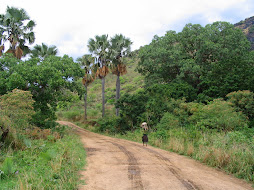
The picture from the blog that has the pretty mountains in the background is of the living room. It the same place then, that we had the birthday party. My hut is off to the left of that one. I will send that next time. Uploading pictures takes about a half and hour or so to put a few pictures on here. I will do it Berra, berra (slowly, slowly).

Also, I thought I'd add that I'm on an all carb diet- sorry Atkins. For breakfast Chapatis (like a pancake/pita), for lunch rice or chaptis with beans and sometimes slimy okra, and then for dinner rice and beans or a type of mashed potatoes (but corn flour) that tastes like eating dirt (called Asiita), mixed with beans or some kind of slimy green. For now, Peanuts and peanutbutter is also on the menu. Peanut are called Fuul or g-nut (ground nut) and peanut butter is called Ka'morte. It is good with honey on a chapati, but is rough on the stomach b/c I eat it uncooked and the ka'morte is ground and mashed in the same place the chickens run around. Well, that's all for now!

Birthday Party


I had a nice brithday party yesterday, full of chocolate cake baked in a charcoal oven by Andrea, biscuits (cookies) proveided by Agnes, as well as Strawberry drink, coffee, candy and new friends. My Sudanese friends thought that the sprinkled on the cake were beads! We assured them that they were made of sugar! :) Here are some pictures from the party:
The first one is of some of the people at the party. THis next one is of Calum chowing down on the cake and biscuits. And you can also see the cake, Andrea's arm, and the awesome thermos that keeps water hot for hours.

I hope everyone is enjoying the day. I just found out that WVU beat Maryland by 31 to 14. So that makes me happy! Also, thank God for new friends and charcoal ovens!!

Saturday, September 15, 2007

Ikotos


more pictures TBA :)

Thursday, September 13, 2007

Saabi Takke

This means "my friend" in Juba Arabic. I am learning it slowly while living with a Sudanese family for the next 2 weeks. So, now you know I have made it safely to Ikotos. I also am enjoying my time here, getting to know the culture and the language. The family that I live with, live in the "bush" in a nice compound of 3 huts and one semi-hut that is used as a sitting room. Yes, I do have sun-burn, by-the-way. Yesterday was especially hot and I was playing out in the sun with their 4 year old son, Wanni, who is my new buddy. Today, I am reaping the pain. Besides that Ikotos is very nice and the people here are friendly and happy to have me here to teach (which hasn't started yet). The mountains are foreboding, but beautiful. I will try to upload a picture this weekend. For those who are curious, there is a 7hr. difference from the east coast of the U.S. It is 3:30p.m. here and you all are just waking up!
So, when I got here, the Scotlands (Jordan and Andrea), who are the other missionary family here, informed me that I would be living with a family right away. At first, I wanted to jump back on the plane to Kampala, but after being there, I very much enjoy it. Agnes Ito is the mother (of 21 yrs. old) , Mylesh is the father, Wanni (4yrs) is the oldest, Innocent Malik Solomon (they haven't decided on a name yet, people just give their names to him, 6wks old), and there are 2 child relatives there too-- John (14yrs) and Ajiba (10yrs.). They are fun and love teaching me Juba Arabic-- especially Wanni! I went to Torit last friday, for a South Sudan retreat, to meet all the others in South Sudan, and Wanni cried the whole time that his Kewaja has left him (Kewaja=foreigner). As I walk down the streets of Ikotos I hear children pointing ans shouting "kewaja! Kewaja!" I reply "Kewaja? Kewaja tai? (you Kewaja?) and then laugh with them. It throws them off when I speak Arabic back to them. So, I am learning the language slowly and hopefully in a couple of months, will speaking fully. The Sudanese people respect kewajas much more when they are willing and trying to learn the language. There are many NGOs here to aid with development, but few get down and dirty with the people and few bother to learn the language. AIM is all about learning the language, which is good. The Scotlands have been here for about 3 yrs. and are completely fluent in Juba Arabic. They also are helping me learn. They have a 14 month old boy, Calum, who doesn't know what he wants to say first, b/c he hears 2 very different languages.
Well, that's the report for now. By the way the main news around these parts is whether or not the road to Torit is passable by car or Land Rover; and if there is a plane or helicopter that flys over or lands, even the adults stop their conversation to see if its UN or who it is that is landing-- then if it lands, the children rush to the airsrtip to marvel at the plane and the Kewajas! Also, it is Peanut season (they call it fuuhl or g-nut), which is also very exciting-- you West Virginians can understand that one, you and your apple butter festivals.
Hopefully everyone is well there!